Showing posts with label Interlingua. Show all posts

Saturday, 10 March 2012

Lista del plus potente indianos

In februario 2012 The Indian EXPRESS publicava su nove lista del 100 indianos le plus potente. Le anno passate le Chef-judice de India S H Kapadia era le indiano le plus potente secundo le jornal. 

Esse anno le secretario general del plus popular partito politic in le pais - le Indian National Congress (INC), o simplemente, Congresso - Rahul Gandhi es le indiano le plus potente.

Le prime ministro indian Manmohan Singh non occupa le prime loco in le lista. Su rango es tertie. Le presidente del INC se trova in le secunde position.

Io non pote listar tote le nomines; io es multo pigre. Pro esso, a basso io lista solmente dece del plus potente indianos con su photographia, etate, occupation e su vice in le mesme lista in 2011.


DECE LE PLUS POTENTE INDIANOS
secundo
The Indian EXPRESS


1. Rahul Gandhi
Etate: 41
Occupation: Secretario General de Congresso
Vice in 2011: 12


2. Sonia Gandhi
Etate: 65
Occupation: Presidente de Congresso
Vice in 2011: 2


3. Manmohan Singh
Etate: 79
Occupation: Prime Ministro de India
Vice in 2011: 4


4. Mohan Bhagwat
Etate: 61
Occupation: Chef de Rashtriya Swayamsevak Sangh (Organisation National de Voluntarios)
Vice in 2011: 42


5. Sushma Swaraj
Etate: 60
Occupation: Chef de Opposition in Lok Sabha (Camera del Communes)
Vice in 2011: 3


6. Arun Jaitley
Etate: 59
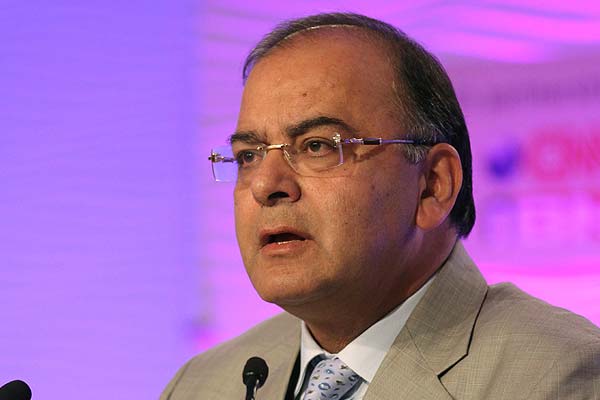
Occupation: Chef de Opposition in Rajya Sabha (Camera del Representatives)
Vice in 2011: 13


7. Mamata Banerjee
Etate: 52
Occupation: Chef-ministro de Bengal Occidental
Vice in 2011: 7


8. Pranab Mukherjee
Etate: 76
Occupation: Ministro de Financia
Vice in 2011: 14


9. AK Antony
Etate: 71
Occupation: Ministro de Defensa
Vice in 2011: 10


10. P Chidambaram
Etate: 66
Occupation: Ministro de Affaires Domestic
Vice in 2011: 15


Thursday, 23 February 2012

Can there be a unified Punjabi vocabulary?

Creation de Interlinga era possibile proque un grande numero de linguas european usa un vocabulario commun in textos scientific o technical. In Asia del Sud, quanquam, le situation es completamente differente. Ibi il ha un longa historia de divider linguas. On non pote cambiar grammatica e proque on simplemente commencia usar differente parolas. Division del hindustani a in duo linguas es un exemplo famose. Infelicemente panjabi potera haber le mesme fato.

=====================================

Interlingua was possible in the first place because chief European languages have more or less a similar learned vocabulary. When it comes to creating new words the languages there invariably turn to either Latin or Greek, resulting in a situation where a person who is fluent in one language can at least get an idea of what a scientific or technical paper is about in another. T

he same, to some extent, I believe is true of Chinese and Japanese where a speaker of either language can at least get the gist of a scientific or technical paper because Classical Chinese serves as the source.

The situation is, however, radically different in South Asia where we have let irrationality take over us in past and have divided a single language (Hindustani) into two on the basis of learned vocabulary and are on the verge of repeating the same mistake once again with Punjabi.

In a sense it is a good thing that Punjabi is not a recognised language in Pakistan. If it were the government there would have to create new vocabulary and, given the antagonism between India and Pakistan, it's unlikely that they would use the term rajdhani (Eastern Punjabi, EP) for capital when dar-ul-hakumat is ideologically more attractive.

When we couldn't even agree on creating a single Punjabi Wikipedia, I sincerely doubt if we would ever agree on a mutually comprehensible vocabulary. Despite having two hugely disparate writing systems, the Chinese have got only one Wikipedia. The same goes for the Portuguese Wikipedia where significant differences in vocabulary and orthography didn't split it into two.

The Serbs manage their two scripts very well so I don't know what gets in the way. The automatic script conversion software is in beta stage. Therefore technology is not a barrier. At the same time it would be naive to think it is the Punjabi ego that comes in the way. The real reason lies in ignorance. 

I bet most people here aren't ever aware of the fact that about two-third people in Pakistan speak Punjabi. Years of propaganda has created a false notion here that everyone in Pakistan speaks Urdu. I am not aware of the conditions on the other side of the border but they must not be very dissimilar.

Anyway, there isn't much I think I can do. So just for fun I have collected half-a-dozen words (if I had free time I would have done better) that are either Western Punjabi or Eastern Punjabi but may not be understood when on the different side of the border:


English Eastern Punjabi Western Punjabi
Article nibaṃd mazmūn
Capital rājdhānī dar-ul-hakūmat
Astronomy khagol-vigyān falkiyat
World War viśva-yudh jang-e-azīm
Philosophy darśan falsafā
United Nations saṃyukta rāśṭar akvām-e-mut'hada

Thursday, 22 December 2011

Mondial, Interlingua, Lingua Franca Nova and Occidental

Mondial, Interlingua, Lingua Franca Nova (LFN) and Occidental are all based on Romance languages. No wonder they (except LFN) are so similar and yet each comes with a different flavour. 

Interlingua is so much Italian and French and Spanish at the same time. It is so erudite and cultured.

Mondial is the Romance spirit liberated somewhat from the chains of tradition. It is like a gentle breeze on your face on a hot and sunny day.

The use of so many consonants gives Occidental an English feel; Germanic with a lot of Romance influence.

Despite its Romance origins LFN is so 'other' that you are inclined to discard it as ugly. But then you think of creoles and the vibrant culture many creole speaking societies have and suddenly it starts making sense and what was earlier 'ugly' now becomes 'exotic.'

Here is the part one of the short story The Fairy which I found in Mondial here and translated into Interlingua, Occidental and Lingua Franca Nova (I've never studied Occidental and LFN so kindly let me know if you find a mistake.); and, of course, English.

LE FEA (Mondial)

Un vidua havi du filias. Le plu viel evi si simil al matre per su caracter i face, que chascun, que vidavi lei, povavi pensar, que il vida le matre; li ambe evi si desagreable i si fier, que on non povavi vivar con les.

Le plu jun filia, que evi le plen portrete de su patre selon su bontá i honestitá, evi ultre lo un del mas bel filies, le queles on povavi trovar.

LE FEE (Interlingua)

Un vidua habeva duo filias. Le plus vetere era assi simile al matre per su character e facie, que alicuno, qui videva la, poteva pensar, que illes vide le matre; illes ambe era assi disagradabile e assi fer, que on non poteva viver con les.

Le plus juvene filia, qui era le plen portrait su patre secundo su bonitate e honestitate, era ultra illo un del maxime belle filias, le quales on poteva trovar.

LE FEA (Occidental)
(Corrected by friend Olivier)

Un vidua havet du filias. Li plu etosa esset talmen simil al matre pro su carácter e facie, que chascun, qui videt la, posset pensar, que il videt li matre; li ambas esset talmen desagreabil e talmen fier, que on non posset viver con les.

Li plu yun filia, qui esset li plen portrete de su patre secun su bontá e honestitá, esset ultra to un del maxim bell filias,  queles on posset trovar.

LA FE (Lingua Franca Nova)

Un vidua ia ave du fias. La plu vea ia tal simile a la madre a causa de caracter e fas de el, ce cada un, ci ia vide el, ia pote pensa, ce el vide la madre; los ambos ia tal desplasente e tal orgulos, ce on ia no pote vive con los.

El plu joven fia, ci ia la plen portreta de padre de el seguente bontia e onestasia de el, ia plu un de la plu bela fias, ci on ia pote trova.

THE FAIRY (English)

A widow had two daughters. The disposition and face of the older daughter was so similar to her mother that any one who saw her could think he/she was seeing the mother; they were both so rude and puffed up to live with.

The younger daughter whose kindness and honesty made her a complete portrait of her father was, besides, one of the most beautiful daughters you could find.

Is Punjabi going the Hindustani way?

Summario in Interlingua

Panjabi es le lingua del populo del region Panjab que es dividite inter India e Pakistan. Plus que 100 million personas parla le lingua ma le situation currente del linguage non es ben. Il ha duo graphias e parlatores de duo Panjabes non comprende le graphias de le un le altere. Anque il ha un problema de excessive persianisation o sanskritisation. Si le curso non cambia le lingua serea devenir duo separate linguas, como occurreva al hindustani ante 100 annos (hindi e urdu). Ancora religion joca un importante parte. Malgrado le facto que plus que un medio de parlatores es islamic, le lingua es frequentemente ligate a sikhes.

Resumo en Esperanto

La panĝaba estas la lingvo de l'lonĝantoj de l'regiono Panĝabio,  kiu dividiĝas inter Barato kaj Pakistano. Pli ol 100 miliono personoj parolas la lingvon sed la nuntempa situacio de l'lingvo ne estas bona. Ekzistas du skribsistemoj kaj parolantoj de du Panĝaboj ne komprenas la skribsistemojn de l'unu la alian. Ankaŭ estas problemo de uzi neogolismojn el aŭ la persa aŭ la sanskrita. Se la tendenco ne ŝanĝas, la lingvo devenos du apartaj lingvoj, kiel okazis al la hindustana antaŭ 100 jaroj (la hinda kaj la urdua). Ankaŭ religio ludas gravan rolon. Malgraŭ la fakto ke pli ol duono da parolantoj estas islamanoj, oni ofte rilatas la lingvon al siĥoj.

=========================================

A hundred years ago Hindustani was the lingua franca in South Asia. Then surfaced religious tensions and the language was spilt into two. Now depending on which side of the border you are Hindustani is now Hindi or Urdu. A hundred years later, history seems to be repeating itself with Punjabi.

Of the 100 million or more Punjabi speakers, more than 70% live in Pakistan and for most of the remaining India is their home. A Punjabi from Eastern Punjab (India) is more likely to communicate well with a fellow Punjabi from Western Punjab (Pakistan) if he/she has lived most of his life in his/her village and has very little formal education than a "cultured" Punjabi. 

Here a "cultured" Punjabi is generally understood in the cities as someone who doesn't know his language well and talks in Hindi/Urdu or English much of the time. It is these people who have the most difficulty in talking with fellow Punjabis from the across the border in Punjabi.

This is an interesting phenomenon. Because in contrast to European languages, where much of the learned vocabulary is more or less similar even though the colloquial speech may have nothing in common with each other, we fight over the issue of learned vocabulary even though the colloquial speech is virtually indistinguishable.

This is as much true of Punjabi (Western and Eastern) and it is of Hindustani (Hindi and Urdu). Unfortunately I don't speak other Indian languages to comment on what is their situation.

In case of Punjabi the list of issues facing the language is long, but chief among them, from linguistic point of view, are:

1. Use of two Different Scripts

The use of two different scripts to write Punjabi isn't unique to the language and the solution isn't to discard one script in favour of another or adopt a Latin characters based script as I had suggested in an earlier post. We can learn from the Serbians and teach people both scripts on the both sides of the border. If the Japanese can handle three different scripts simultaneously we shouldn't have much of a problem especially when the task of learning Shahmukhi (37 letters) and Gurumukhi (41 letters) is nothing compared to the astronomical amount of effort required to learn Kanji (>2,000 characters).

2. The Issue of Excessive Persianisation or Sanskritisation

When I was a child I used to write a 'student' sṭudenṭ in Punjabi. Now nowadays vidyārthī (Sanskrit/Hindi influence) is more popular on this side of the border and if I'm not wrong the Pakistani Punjabis use tālib-e-ilm (Persian/Urdu influence). I find vidyārthī ugly and tālib-e-ilm is an unnecessary inconvenience. We have borrowed words from English in the past and have successfully indigenised them. No one considers botal (bottle) and haspatāl (hosptial) as foreign. The upshot is when it comes to learned vocabulary we can either get the Western scientific vocabulary adapted or can create new words from existing roots. There is no harm is borrowing from Sanskrit or Persian but the process should be natural.

3. Linking the Language with Religion

Up until the 1930s all Punjabis spoke their tongue. Then a man called Master Tara Singh started promoting Punjabi as the language of Sikhs. This exacerbated the already heightened religious sentiments. As a results Hindus increasingly started identifying themselves with Hindi and Muslims with Urdu. It's just like Bosnians insisting their language is not Serbian. How this tendency can be overcome, I have no idea. But the language will certainly get an impetus if we stopped viewing Punjabi as the language of Sikhs. We must understand they haven't got a copyright!

If the fate of Hindustani befalls Punjabi will depend on factors - politics and religion - that aren't mentioned here. But one thing is for sure: accept the laissez faire and we will have two mutually incomprehensible Punjabies in the coming decades.

Thursday, 15 December 2011

What makes Esperanto special among auxlangs?

Summario

Que face esperanto unic inter omne linguas auxiliar?

Il ha sex factores lo que io pote pensar in iste momento e illes son:

* le amonta del litteratura disponibilie,
* demographia de parlatores,
* phenomenos unic a esperanto,
* su rolo como un lingua auxliar inter auxliaristes,
* cognoscentia que existe esperanto in qualque governamentos,
* e su uso practic.

===========================================

Esperantists often proudly talk of their language as "the language of peace and harmony." A bridge that aims to break linguistic barriers and end "linguistic imperialism." Impressive as this may seem this isn't what makes Esperanto special. There are at least a hundred auxlangs that aspire for the same. These "projects" occasionally only to disappear into oblivion a little later but Esperanto has somehow survived for more than a century and can today be classified as a minority language. So what it is that makes Esperanto stand out?

1. Materials available:

Of the thousand or so auxiliary languages in the world only a few will have a whole book translated into them. Most of the time these books are novella-size. To my knowledge Esperanto and Interlingua are the only auxiliary languages that can boast of more than a dozen translated or original books that run into hundreds of pages. Even among these Esperanto books far outnumber the books available in Interlingua. Whereas you can find a book on virtually any subject in Esperanto, fiction is perhaps the only genre where Interlingua has a respectable presence and there too European works dominate. That means even the most serious competitor falls far short in terms of the amount of works present in the language.

2. Demography of its speakers:

Esperanto speakers are spread throughout the world and their occupations are varied. This makes the community extremely vibrant. The same can not be said of other auxlangs. With most of its speakers coming from the Scandinavian countries I doubt if there are even 100 speakers of Interlingua in Africa and Asia combined. Talking of other languages - leaving for a few exceptions like Babm and Afrihili - most speakers of other auxlangs are white men (no racism intended) from First World countries. With Esperanto, I believe there is a significant proportion of speakers outside the First World countries (40,000 in China alone).

3. Phenomena unique to Esperanto:

There is an interesting phenomenon in Esperanto called eternaj komencantoj (eternal beginners). That means a lot of people start learning Esperanto with a lot of excitement but sooner than later give up. Then they either look for another auxlang or create one. A lot of new projects never get off ground and many kabeists (deserters) come back and remain eternal beginners for the rest of their lives. I have yet to meet or read about a person who started off with an auxlang other than Esperanto has turned to Esperanto, become a kabeist or eterna komencanto.

I guess there is something in the grammar of Esperanto that makes it usable despite its many "flaws" and the significant effort that has to be put into learning it.

4. The lingua-franca among auxlangers:

There isn't perhaps an auxlanger or auxlang speaker who hasn't studied Esperanto at one point in his/her life. No other auxlang can claim the same and this is what makes Esperanto special.

5. Awareness among several governments:

In China there is an Esperanto version of the website of a national broadcaster (Chinese equivalent of BBC) CRI. Radio Havana broadcasts news in Esperanto and in Hungary it is an optional second language in schools. It may soon be introduced in Brazil as an optional second language. No other auxlang enjoys similar official status. Interlingua forms an anomaly here as a student of linguistics can take it as a subject at a Spanish university. Unfortunately the name of the university has slipped out of my mind.

6. Practical use:

Unlike most other auxlangs you can immediately put Esperanto to some practical use after learning it. You can talk to people outside the Anglosphere, use Pasporta Servo to save money and make friends while travelling and do all sorts of interesting things. That is currently only possible with a handful of auxlangs.

FINALLY

It is possible that the last four features could be only the consequences of its popularity(2) and the amount of literature available(1). But that will not be proved unless we have another auxlang that is at least as successful.

Also, I didn't write it as pro-Esperanto propaganda. I only wanted to objectively list some of the features that make this language so unique. In fact my favourite language is INTERLINGUA! Just that I am not yet proficient at it.

Sunday, 13 November 2011

An Indian Interlingua - Antarbhasa

I have a confession here. To my knowledge, there doesn't exist any Interlingua equivalent of Indian languages. But that doesn't mean it isn't possible. The languages of India are sufficiently close so that a common vocabulary can be extracted and joined together by a simple grammar.

So, what's the language situation like in India?

Well, there are 103 languages spoken in the country and the speakers of the 12 major languages account for 90 per cent of the population. That's a major relief because instead of more than hundred languages, we can safely limit ourselves to the Big 12 and assume at least 9 out of 10 people will be able to relate to it.

These Big 12 are: 

1. Hindi (40%)
2. Bengali (8-9%)
3. Telegu (8-9%)
4. Marathi (6-7%)
5. Tamil (5-6%)
6. Urdu (5-6%)
7. Gujarati (4-5%)
8. Kannada (3-4%)
9. Malyalam (3-4%)
10. Oriya (3-4%)
11. Punjabi (2-3%)
12. Assamese (1-2%)

Of the Big 12, eight (in bold) are direct descendants from Sanskrit and the remaining four belong to the Dravidian family of languages. Let's deal with them one at a time: 

Sanskrit Descendants:

Those descended from Sanskrit have similar vocabulary and almost identical grammars. For an analogy, you can think of Sanskrit as Latin and its descendants as Romance languages.

Also, Hindi and Urdu have so much in common that it is impossible to distinguish the colloquial speech. 

The learned vocabulary is derived from Sanskrit; Urdu is the sole exception here. It prefers to borrow from Persian and Arabic.

Each of these languages, Marathi being an exception, has a script of its own and they are mutually incomprehensible.

On the plus side we have more or less a common word stock and similar grammars to begin with.

Dravidian Family: 

I haven't got much to say here because I don't speak any Dravidian language. But I do know that their grammars have nothing in common with the first group. 

Fortunately, they have borrowed from Sanskrit. I read a couple of years ago in The Tribune that 90% of words in Malyalam have Sanskrit origin. Tamil is the farthest you can get in terms of non-Sanskrit vocabulary. Still, I read that in a dictionary, 40% of its vocabulary comes from Sanskrit. 

Using the same analogy, you can think of the Dravidian group as English that has borrowed a lot from Latin but has kept its grammatical features intact.

Now that we have a word stock to start with, we can start registering and standardising a pan-Indian vocabulary. But how are we to go about it?

A way forward is to pick up a word as see how it appears in all the languages of the Big 12. If it has a similar form and meaning in 7 languages, it is accepted into Antarbhasa. A downside of this approach is that we will not have many Dravidian words because there are only four of them in the list. Also, it is not wise to give Hindi and Assamese equal voting power. Hindi is understood by more than half of the Indians but Assamese, on the other hand, is hardly spoken outside the tiny state of Assam. To overcome this, here is my proposal: 

Divide these languages into three groups. The first group will include Hindi and Urdu; Oriya, Bengali, Marathi, Assamese, Punjabi and Gujarati will be in the second Group and the Dravidian languages are put in the third group. 

After assigning the languages separate groups, we treat each group as a single entity and only when a word is common in at least two of them, does it become a part of Antarbhasa. English and Persian will be referred if there isn't a common ground. That's because these two languages, at different times, have been the official languages of the country since 1400 or 1500 AD. And if even that doesn't help, let Sanskrit come to rescue.

That's only my idea. I may be way off the mark. But it would be interesting to work on such a project. I don't know if Nikhil wants to work on something like this.

Once we have the vocabulary at our disposal we can start thinking of grammar. And given that there are eleven different scripts for these Big 12, the question of an official script is going to cause much heated debate.

Sunday, 6 November 2011

Three Useful Artifical Languages to Learn

There are perhaps as many artificial languages (auxlangs) in the world as natural languages. Unfortunately, only a few of these languages have more than a dozen speakers. With perhaps more speakers than all the other auxlangs combined, Esperanto has been the queen of the field for the past 100 years. 

Other than Esperanto there are many exciting auxlangs and conlangs. For instance, one of them (Toki Pona) doesn't have more than 123 words to talk about everything in the world, while the vocabulary of another (Sambahsa) is inspired from proto-Indo-European (a language believed to be the mother of all Indo-European languages) and still there is a third (Lojban) that claims to have the most logical grammar. 

Exciting as these languages are, I wonder if an ordinary guy on the street has much use of them. To my knowledge there exist only three languages, that you can put to some practical use after learning and these are: 

1. Interlingua

It's my personal favourite. If you are reading this, you will find Interlingua the most familiar. It has its vocabulary extracted from the five major world languages namely English, French, Italian, Portuguese and Spanish. Add to that occasional sprinkling of words from German and Russian and you get a language that, with the exception of the Middle East and the Far East, can be used everywhere. 

It is common to hear that there are exceptions and irregularities in Interlingua. Fortunately, you won't even notice them if you speak any of the source languages. How many of you would raise eyebrows on reading that Interlingua es is 'is' and son is 'are'? This is perfectly natural, isn't it?

There are two major advantages of learning Interlingua: 

  • You get an insight into how Romance languages work and after spending a few months you begin to get the gist of texts in source languages (except English).
  • Your English vocabulary takes a boost.

2. Slovianski

They call it the Slavic counterpart of Interlingua. The methodology of extracting vocabulary is more of less the same but there are more source languages - Russian, Ukrainian, Belarusian, Polish, Czech, Slovak, Serbian, Bosnian, Croatian, Slovene, Bularian and Macedonian - and all of them are Slavic. A grammar of the language is available on this website but I haven't found any lessons yet. Therefore, I don't know how much it will help you in the understanding of Slavic languages. However, when I showed a few Slovianski sentences to a Russian friend, he understood almost everything.

Just like Interlingua, there are irregularities and exceptions. The difference is: we will feel the pinch this time!

And it should give you a taste of writing and reading in Slavic languages within a few months of study.

3. Esperanto

Esperanto doesn't help you understand any language. It looks ugly. The Chinese, Japanese and Koreans don't find it easy. Most speakers of the language prefer to talk about Esperanto than any other topic and they look down on other artificial languages, often calling it a "waste" of time and energy. Still, it among the three and the reason it the strength of its speakers. They are spread all over the globe and by even the most conservative estimates, there are at least 10,000 of them.

There are lots of books in Esperanto and if your dream is to see the world but you are tight on cash, Pasporta Servo (Passport Service) can help you. Through Esperanto, I have talked to people from China, Lithuania, Romania and the Democratic Republic of Congo and have learned how similar we are. But again, even here discussion about Esperanto takes at least 10% of the time.

Therefore if you are looking for a way so that you can start talking to people from all over the world without using Google Translate, Esperanto is the way to go.

===================================================

I wanted to add Frenkisch too but I don't think it's ready yet and I don't know a non-English Germanic language speaker who can tell me how effective the language is.

Wednesday, 21 September 2011

Interlingua Wikipedia - Unethically raising the Article Count?

There is something queer happening on the Interlingua Wikipedia. I remember until the beginning of this month, there were about 5,500 (give or take a hundred) articles on the Interlingua version of the Wikipedia. The number today, only three weeks later, stands slightly above 9,100. Roughly speaking, this is an increase of 3,500 articles in less than three weeks. This sounds impressive. Perhaps there is a sudden interest in the language. But wait a minute. 

When you look at the number of active users, who have made at least one edit in the past 30 days, it is only 65 according to the data on the Statisticas page (Esperanto Wikipedia has 468, for comparison) and 50 of them are automated computer programmes or bots. It means either the remaining 15 people wrote all of the 3,500 or so articles (approximately 233 articles per head) or the lovers of the language have turned to playing the same game Volapukists played a couple of years ago. Back then a series of automated computer programmes had created articles on the Volapuk Wikpedia at a breathtaking speed. It now has over 100,000 articles. Of these two possibilities, the second one sounds more plausible.

Almost all the articles created in the past few weeks are one or two line articles and most of them are about cities, towns and villages in Spain and Vietnam. It is unlikely that 15 people suddenly developed an interest for geography and none of them wrote more than one or two sentences.

I believe these bot created articles will add little, if any, value to the Interlingua Wikipedia. The move could indeed backfire as new students may get discouraged on finding these stubs most of the time they look for something on the Interlingua Wikipedia. The editors, or whoever is behind this, should better concentrate on creating a few but quality articles, like these ones. (I wrote them!) ;)

Here is a screen shot of the Statisticas page on 21 September, 2011:


Thursday, 21 July 2011

Auxlangers Today


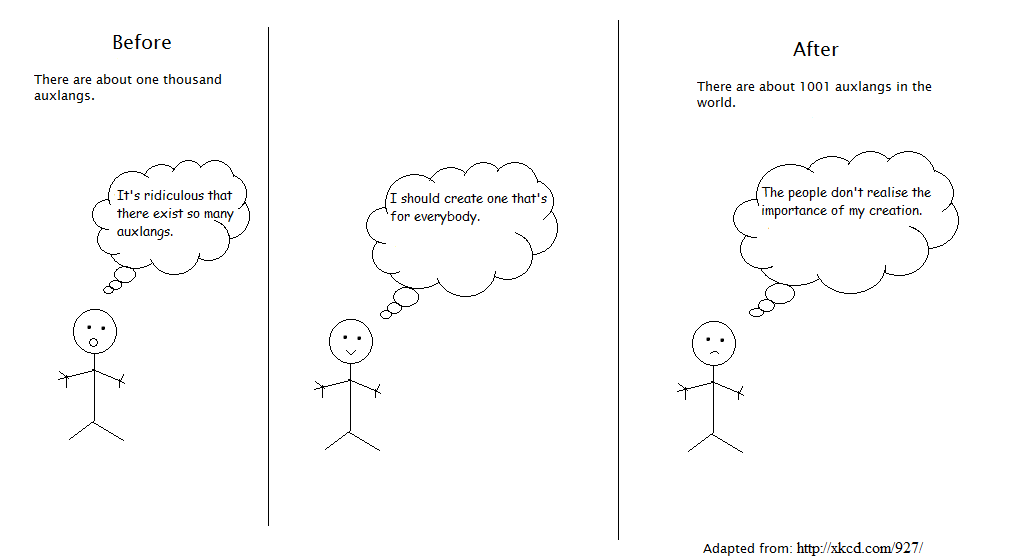
This is my second attempt at creating comic strips. This one is an adaptation of How Standards Proliferate on xkcd.

Here is the Esperanto version of the same strip:


NOTE: These are later additions. :)

Here is the Interlingua version, translated by Martijn! :)


Here is a version (corrected by Dimitrij) in Lingwa de Planeta (LdP):


I have dabbled in LdP for less than an hour and have translated this using a dictionary on the LdP's website. Therefore it may contain a few mistakes. Kindly let me know if you find any. I would be glad to make corrections. :)

Sunday, 3 April 2011

Internet and Constructed Languages

One of the arguments you often hear from those who propagate Esperanto is that it has taken off from the drawing board and become a living language. To support their claim they often ask you to google Esperanto and look at the number of results you get. 

I've done the same just now. Today is 3 April, 2011 and at 09:54 am, Google came up with more than 78 million results to my search query Esperanto. In contrast, with merely 122,000 results, its closet competitor, Interlingua (IALA), doesn't stand anywhere near.

Impressive! But does it tell the whole story? The answer is no because if that were the case Google wouldn't have showed me about 140 million results for learn latin and just (relatively) 130 million for learn french. The number further drops to 81 million for learn spanish and doesn't even cross the 19 million mark when you type in learn portuguese.

Does that mean more people are studying Latin or speak it than any of these modern languages? I think... nah!

I'm a computer illiterate so I don't know what these numbers signify but I think they point towards one thing - these numbers don't reflect the reality as we understand it. And if that's true, it is time we took a serious look at other constructed languages.

By the way, history of mathematics has only 19 million results which is not even half of the 45 million you get when you google history of underwear. ;)

Friday, 18 March 2011

Quante ric es le Riccos Indian?

Sape vos jam como facer addition e division? O, in parolas altere, como adder e divider per numeros? Sin dubita vos respondera affirmativemente!

Nunc io ha un problema mathematic. Si il vos place, adde le numeros, qui vos trova sur isto sito web. Ecce numeros representa le ricchessa del 100 plus ric Indianes in milliones dollares statounitese.

Io jam ha facite le addition e io trovava ci resultato: $300,292 milliones dollares statounitese. Ecce representa le ricchessa combinate del 100 plus ric Indianes.

Nunc divide le resultato per US $1,310,000 milliones. Isto numero es le Producto Interior Brute (PIB) de India.

Quando io divideva ecce duo numeros e multiplicava le resultato con 100, io trovava 23 (approximativemente). Un studento pro mathematic pote facilemente explicar a vos que 23 es le percentage que monstra que sol 100 persones in India possede 23% su PIB.

Congratulationes! Vos justo nunc ha trovate que ricchessa del plus 100 face 23% ricchessa de India; un pais de 1,155 milliones persones.

Que es le condition in vostre nation?